

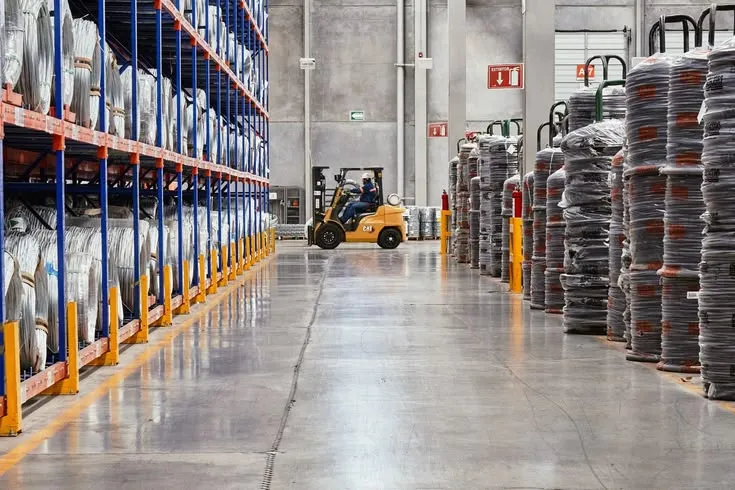
Warehouse floors rarely experience equal wear across every square foot. Aisles used by forklifts, loading zones, turning points, expansion joints, and pallet-staging areas usually deteriorate faster than low-traffic sections. These concentrated stresses can lead to cracked joints, chipped concrete, worn coatings, and increasingly rough travel paths. Rather than treating flooring deterioration as a uniform problem, facility managers can make better maintenance decisions by understanding where mechanical stress occurs and why certain areas repeatedly require attention.
Forklift Traffic Creates Concentrated Wear
Forklifts place substantially different forces on floors than ordinary pedestrian traffic. Vehicle weight, wheel type, load size, braking, acceleration, and turning all influence surface wear.
Straight travel generally creates less stress than repeated sharp turns. Areas near rack ends, loading bays, and staging points can therefore deteriorate more quickly because vehicles brake, turn, or change direction frequently.
Mapping these traffic patterns can help managers identify which sections may require stronger flooring specifications or more frequent inspection.
Joints Are Common Failure Points
Concrete joints are necessary components of many warehouse slabs, but they can also become vulnerable under repeated vehicle traffic. Forklift wheels crossing deteriorated joints can gradually chip or break the concrete edges.
Once joint damage begins, each vehicle crossing may make the problem worse. Rough transitions can also affect equipment movement and increase vibration as loaded vehicles pass over them.
Working with a qualified Warehouse Flooring Installer should include an assessment of existing joints before a new resinous system is applied. Damaged edges may need repair, while functioning movement joints should receive treatment appropriate to their purpose.
Surface Preparation Affects Durability
A resinous floor depends on its bond with the concrete below. Dust, weak surface material, previous coatings, oils, and other contaminants can reduce adhesion if they remain in place.
Mechanical preparation methods such as grinding or shot blasting can remove unsuitable material and create the surface profile required for the flooring system. Areas damaged by forklifts or pallet movement should also be repaired before coating begins.
Preparation is particularly important in high-traffic zones because any weakness beneath the coating is likely to be exposed more quickly where mechanical stress is greatest.
Turning Areas Need Extra Attention
Forklift turning zones deserve special consideration during flooring design. Wheels can create lateral forces as vehicles change direction, causing additional abrasion compared with straight-line travel.
These areas may include intersections, rack ends, receiving zones, charging stations, and approaches to loading docks. Managers should identify them during the project-planning stage rather than assuming a uniform system will experience identical wear everywhere.
The flooring contractor can then determine whether changes in system build, preparation, or protective finish are appropriate for these high-demand sections.
Compare Contractors by Specification
Two flooring proposals can appear similar while containing very different preparation and repair allowances. One may include extensive joint restoration and mechanical profiling, while another concentrates mainly on applying the coating.
When facility managers compare the best epoxy floor contractors, they should examine how each proposal addresses existing warehouse damage. Questions should cover joint treatment, crack repair, concrete preparation, flooring layers, curing requirements, and high-traffic zones.
A detailed specification makes it easier to understand what the facility is actually purchasing rather than comparing proposals solely by square-foot price.
Loading Areas Face Multiple Stresses
Loading docks can combine vehicle traffic with outdoor moisture, dirt, pallet movement, and concentrated impact. These conditions often make dock approaches and nearby staging areas some of the most demanding parts of a warehouse.
Rain or snow may also enter through open loading doors, increasing the importance of suitable traction. However, extremely aggressive texture can make cleaning more difficult.
Managers should consider both vehicle movement and environmental exposure when determining the appropriate surface characteristics for these areas.
Regular Inspections Can Reduce Larger Repairs
Warehouse floor inspections should concentrate on predictable wear points. Joint edges, forklift intersections, loading docks, rack ends, and heavily used aisles are logical places to start.
Small chips or coating damage can often be addressed more easily before repeated traffic enlarges them. Maintenance teams can photograph defects and track whether they are growing between inspections.
Keeping simple records also helps determine whether recurring damage is caused by isolated impacts or indicates that a particular flooring area needs a more substantial upgrade.
Conclusion
Warehouse floor life is influenced heavily by where and how material-handling equipment moves. Forklift turning forces, repeated joint crossings, loading activity, and concentrated traffic can create deterioration long before lightly used areas show significant wear.
A stronger flooring strategy therefore begins with traffic patterns rather than treating the warehouse as one uniform surface. By identifying high-stress zones, repairing concrete properly, preparing the substrate mechanically, and inspecting vulnerable areas regularly, facility managers can reduce recurring damage and build a more practical long-term maintenance plan.