

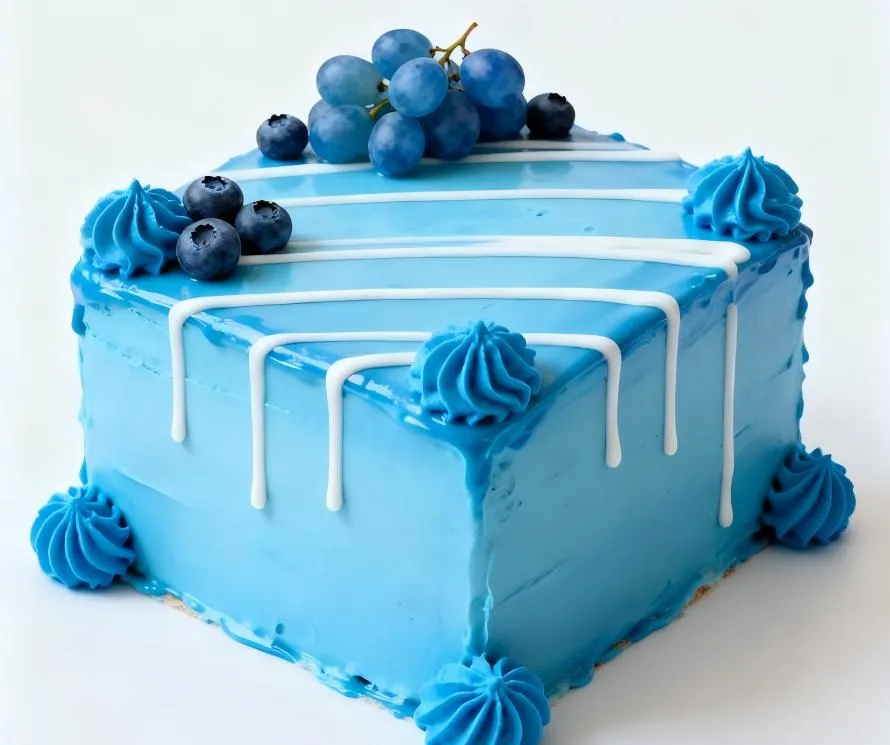
A search for organic food coloring often begins with the idea of using plant-derived shades, but frosting adds its own technical questions. Butter, sugar, water, emulsifiers, and flavorings can all change the way a color appears once it is mixed. FoodRGB offers natural colors for frosting, buttercream, glazes, and icing in powder and liquid forms. Before a team approves any claim or shade, it should confirm the exact ingredient documentation and test the color inside the finished frosting rather than judging a sample prepared separately.
Blue Is Harder Than It Looks
Blue is one of the more difficult natural shades to formulate because fewer suitable sources are available compared with red or yellow. In frosting, opacity can help the color look fuller, but fat content and background whiteness still influence the final tone. FoodRGB lists Gardenia Blue as a blue option for frosting and other baked applications. A developer should test more than one concentration, since a slightly lower dose may produce a cleaner pastel shade while a higher level can create a deeper decorative finish for cakes and pastries.
Gardenia Blue Offers Useful Stability
Gardenia blue is a water-soluble color derived from gardenia fruit material. FoodRGB lists a stable color tone from about pH 4.0 to 10.0 and also offers an acid-resistant version designed to avoid precipitation between roughly pH 2.5 and 4.0. The company supplies powder, liquid, acid-stable, and custom formulations. For frosting work, the powder form is especially relevant because FoodRGB identifies Gardenia Blue powder as a heat-stable and light-stable blue option in its frosting application guidance for commercial bakery and confectionery products.
Fat Content Can Change the Mixing Method
Buttercream, whipped frosting, glaze and icing do not have the same composition, so the color should not be added in the same way every time. A water-soluble powder may disperse easily in one formula but need pre-dissolving in another. Higher-fat systems can make mixing more demanding, particularly when the base is thick. Developers should test the planned addition point, mixing speed, and color concentration on a small scale. Good dispersion matters because streaks or specks become highly visible on smooth decorated surfaces after application.
Light Exposure Matters on Display
Decorated cakes and pastries may spend hours under bakery lighting or inside refrigerated display cases, so light resistance deserves attention. FoodRGB describes Gardenia Blue as light-stable in frosting applications, but the finished product should still be checked under realistic display conditions. Frosting thickness, packaging, and exposure time can all affect what customers see. A useful trial compares the same decorated product immediately after finishing and again after normal display or storage. This shows whether the shade stays attractive rather than relying only on the appearance of freshly mixed frosting.
Temperature Changes Should Be Included
Frosting may not go through a baking step, but it can still experience temperature changes during mixing, refrigeration, transport, and display. Some glazes are applied warm, while buttercream can soften when held above refrigeration temperature. FoodRGB says Gardenia Blue is heat stable for frosting, but every recipe generates its unique environment. Development teams should check the color after chilling, warming, and returning the product to serving conditions when relevant. That simple cycle can reveal changes in tone or distribution that are not obvious during the first mixing trial.
Scale-Up Can Reveal Uneven Color
A small bowl of frosting is easy to mix until the shade looks even. Commercial bakery equipment introduces larger volumes, longer mixing times, and different movement through the batch. A color that appears uniform in a bench sample may show lighter or darker areas when production expands. Pilot batches should include visual checks from several points in the mixer and after the frosting is applied. If variation appears, the solution may involve changing pre-dispersion, addition order, or mixing time rather than simply adding more pigment to the formula.
Conclusion
Natural blue frosting works best when the color is chosen for the complete recipe and production process, not only for its appearance in a sample cup. Gardenia Blue offers useful powder, liquid, and custom options, but dispersion, fat content, light, temperature, scale and labeling claims still need checks. Manufacturers can use foodrgb.com to review natural color systems and application support for frosting and other confectionery products. Testing the real formula through mixing, decoration, display and storage gives teams a stronger basis for approving a shade that stays consistent commercially.